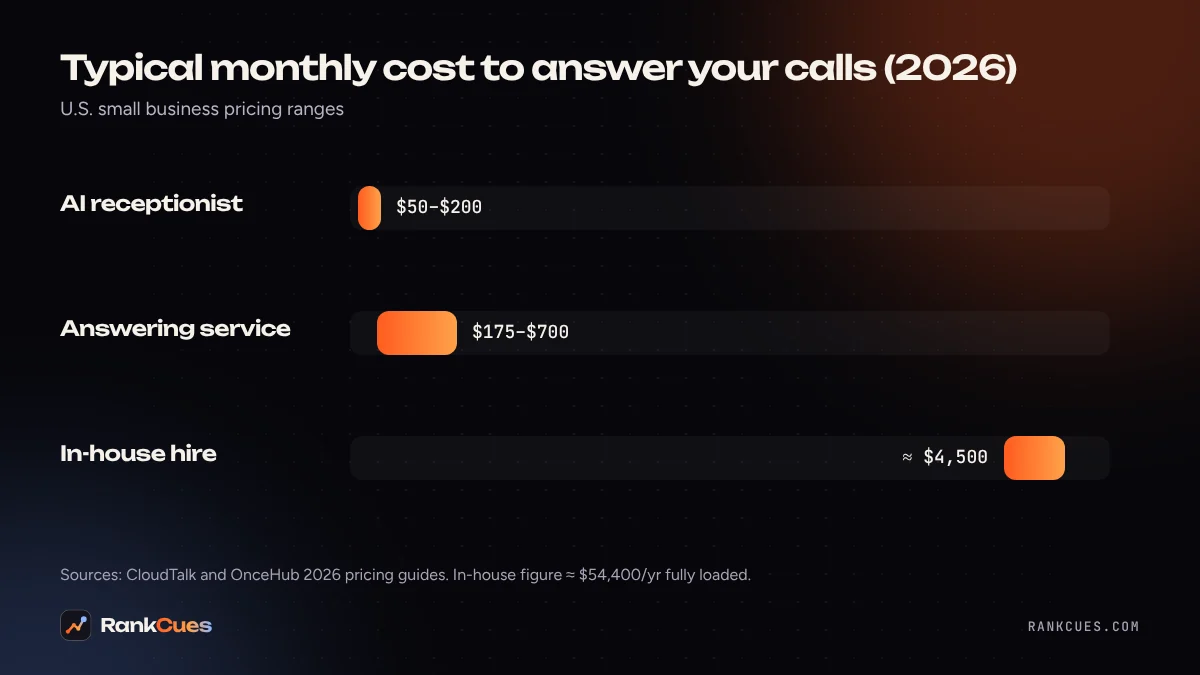
In 2026, most small businesses pay about $50 to $200 a month for an AI receptionist, $175 to $700 a month for a live answering service, and around $54,000 a year for a full-time in-house receptionist once benefits and overhead are included. AI is the cheapest way to answer every call 24/7; people are better for complex or emotional calls. Many local businesses combine the two.
The quick comparison
Every missed call is a customer who may call your competitor next. There are three common ways to make sure someone picks up. Here's what each costs in 2026, based on published industry pricing.
| AI receptionist | Live answering service | In-house receptionist | |
|---|---|---|---|
| Typical monthly cost | $50 to $200 | $175 to $700 | About $4,500 (about $54,000 a year, fully loaded) |
| Hours covered | 24/7, including holidays | Depends on plan | Business hours only |
| Calls at once | Many | Limited by agents on shift | One |
| Cost per minute | About $0.15 to $0.50 | About $1.43 to $5.00 | Fixed salary |
| Best at | Answering every call, standard questions, booking | Messages and simple screening | Complex, personal, in-person work |
AI receptionist
An AI receptionist is a voice assistant that answers your business line, greets callers, answers common questions from information you approve, books appointments into your calendar, and passes urgent calls to your team.
Good for: home services, salons, clinics, and any business that misses calls while staff are busy with customers or after hours. It never puts callers on hold and can take several calls at once.
Watch for: per-minute overage charges, the quality of the voice and answers (always test it live), and set-up time. It works best with clear rules for prices, service areas, and emergencies.
Live answering service
A human answering service routes your calls to a shared team of agents who take messages or follow a simple script. Most bill per minute or per call.
Good for: businesses that want a person on every call but don't need deep knowledge of the business.
Watch for: bills that grow with call volume, hold times at busy hours, and agents who can take a message but can't quote or book.
In-house receptionist
A dedicated person who knows your business, your customers, and your team.
Good for: busy offices with walk-in customers, complex scheduling, or calls that need judgment and empathy.
Watch for: the full cost (salary, payroll taxes, benefits, training), plus cover for breaks, sick days, evenings, and weekends.
How to choose
- Count your missed calls. Check your phone log for one normal week. If you miss calls after hours or during busy periods, you need coverage, not just a cheaper option.
- List your common call types. If most calls are "what do you charge," "are you open," and "can I book," an AI receptionist can handle them.
- Decide what must reach a person. Emergencies, complaints, and big jobs should always transfer to someone on your team.
- Start hybrid. Many local businesses keep their staff on the phone during the day and let an AI receptionist cover overflow, evenings, and weekends.
There's a new reason to get this right: Google's AI can now call local businesses to collect quotes for customers, and a missed call means your business is left out of the comparison.
Want help setting one up?
Our AI receptionist service handles setup end to end: the greeting, your approved answers and price ranges, calendar booking, and rules for transferring urgent calls. Start with a free consultation to see if it fits your call volume.
Sources
- CloudTalk: How much an AI answering service costs in 2026
- OnceHub: Answering service cost in 2026, human, virtual and AI pricing compared
Frequently asked questions
How much does an AI receptionist cost per month?
Most small businesses pay roughly $50 to $200 a month for the AI plan itself, with plans ranging from about $29 to $400 depending on call volume and features. Watch for per-minute overage charges.
Is an AI receptionist better than an answering service?
For answering every call, quoting standard prices, and booking appointments around the clock, an AI receptionist is usually cheaper and never puts callers on hold. For complex, sensitive, or emotional calls, a trained person is still better. A hybrid setup gives you both.
Will callers know they're talking to an AI?
We recommend telling callers they're speaking with an AI assistant. Recording and disclosure rules vary by state, so the greeting should be set up with that in mind.
Can I keep my business phone number?
Usually yes. Most setups forward calls from your existing number to the AI when you're busy, after hours, or from the first ring.
Keep reading
- Google's AI is calling local businesses for quotes. Will it reach yours?
- Google's official guide to AI search, explained for local businesses
- Google Business Profile changes in 2026: a checklist for local businesses
- What your Google Business Profile categories actually do
- Helping AI assistants describe your business accurately
- Five follow-up automations every service business can set up