On May 15, 2026, Google published "Optimizing your website for generative AI features on Google Search." Its main message is that showing up in AI Overviews and AI Mode is still SEO: create useful, original content, keep your site crawlable and fast, and keep your Google Business Profile current. Google also says you can ignore llms.txt files, special AI markup, and splitting content into tiny chunks.
What Google published
On May 15, 2026, Google Search Central released its first official guide to appearing in its AI features, such as AI Overviews and AI Mode. Until then, business owners heard a lot of theories and new acronyms (AEO, GEO) but very little from Google itself.
The headline is reassuring for local businesses: Google says its AI features are built on the same ranking and quality systems as regular Search. In Google's words, optimizing for generative AI search "is still SEO."
What Google says to do
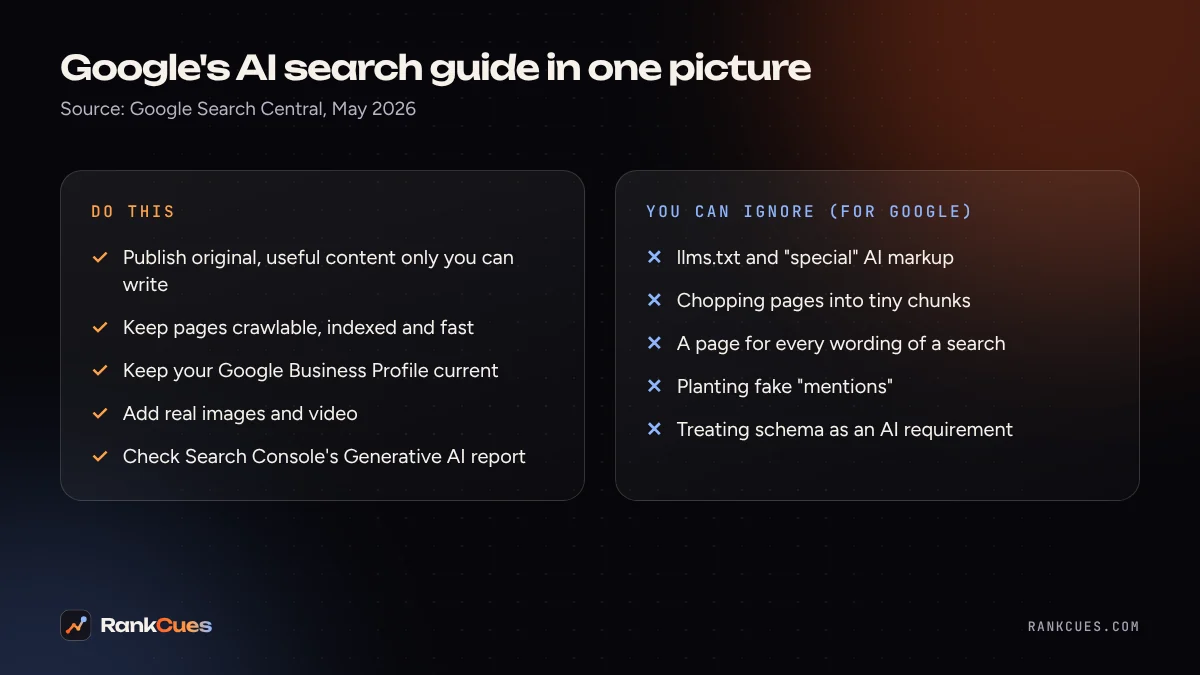
Create original, useful content. Google puts this first and says it will likely matter more than anything else in the guide. For a local business, "non-commodity" content means things only you can say: your real prices or price ranges, photos of your actual work, how you handle common problems in your area, and honest answers to the questions customers ask you on the phone.
Keep your site crawlable, fast, and clean. Pages need to be indexed, eligible to show a snippet, quick to load, and free of duplicate content. If Google can't read a page, its AI can't use it.
Keep your business data current. The guide names Google Business Profile as one of the sources that can help your services appear in AI responses. Accurate hours, services, service areas, and photos matter more than ever.
Use images and video. AI features can show relevant images and videos, which gives you more ways to appear than a plain link.
Track it. Google points to the Generative AI performance report in Search Console. Your site must also be included in Search generative AI features in Search Console to be eligible.
Get ready for AI agents. Google notes that AI agents can now book, compare, and complete tasks on websites. Clear buttons, simple forms, and accessible pages help both people and agents.
What Google says you can ignore
- llms.txt and "special" AI markup. Google Search doesn't use them. They don't help or hurt your Google visibility, though other AI services may read them.
- Chopping content into tiny chunks. Google can understand several topics on one page, and there's no ideal length.
- Rewriting pages for every phrase. Google understands synonyms, so you don't need a page for every wording of a search.
- Fake mentions. Planting "mentions" of your business around the web is less useful than it sounds, according to Google, and spam systems watch for it.
- Over-focusing on schema. Structured data isn't required for AI features, and there's no special AI schema. It's still worth using for normal rich results.
A plan for local businesses
| Priority | What to do | Why it matters for AI search |
|---|---|---|
| 1 | Complete and update your Google Business Profile | Google names it as a source for AI responses |
| 2 | Add a page for each core service, with real prices or ranges, photos, and FAQs | Original content is Google's top recommendation |
| 3 | Fix speed, mobile, and indexing problems | Pages must be crawlable and indexed to be used |
| 4 | Ask every happy customer for a review | Reviews give AI systems specific, current details about you |
| 5 | Check the Generative AI report in Search Console monthly | Shows whether your pages appear in AI features |
The takeaway
There's no secret AI trick. The businesses that appear in AI Overviews and AI Mode are the ones with clear, accurate, original information that Google can crawl. That's good news, because it's work any local business can do. If you'd like to know where you stand, our free business audit includes a check of how AI assistants describe your business, and our AI search optimization service handles the fixes.
Sources
- Google Search Central: Optimizing your website for generative AI features on Google Search
- Google Search Central Blog: A new resource for optimizing for generative AI in Google Search (May 15, 2026)
Frequently asked questions
Is AEO or GEO different from SEO, according to Google?
Google's guide says that from its perspective, optimizing for generative AI search is optimizing for the search experience, and so it is still SEO. Other AI tools such as ChatGPT may work differently.
Do I need an llms.txt file?
Not for Google. The guide says Google Search doesn't use llms.txt, so it neither helps nor hurts there. Some other AI services may read it, so it does no harm to keep one.
Do I need schema markup to appear in AI Overviews?
Google says structured data isn't required and there is no special markup for AI features. It still recommends structured data as part of normal SEO because it can make you eligible for rich results.
How can I see if my site appears in Google's AI features?
Google points to the Generative AI performance report in Search Console. Your site must also be included in Search generative AI features in Search Console to be eligible.
Keep reading
- Google's AI is calling local businesses for quotes. Will it reach yours?
- Google Business Profile changes in 2026: a checklist for local businesses
- AI receptionist vs answering service vs hiring staff: 2026 cost comparison
- What your Google Business Profile categories actually do
- Helping AI assistants describe your business accurately
- Five follow-up automations every service business can set up